Cadet College Entry Test Syllabus 2027 – Complete Subject-Wise Preparation Guide
A complete guide to cadet college entry-test subjects and preparation for 2027, covering Mathematics, English, Urdu, Science, Intelligence and the important differences between major colleges.
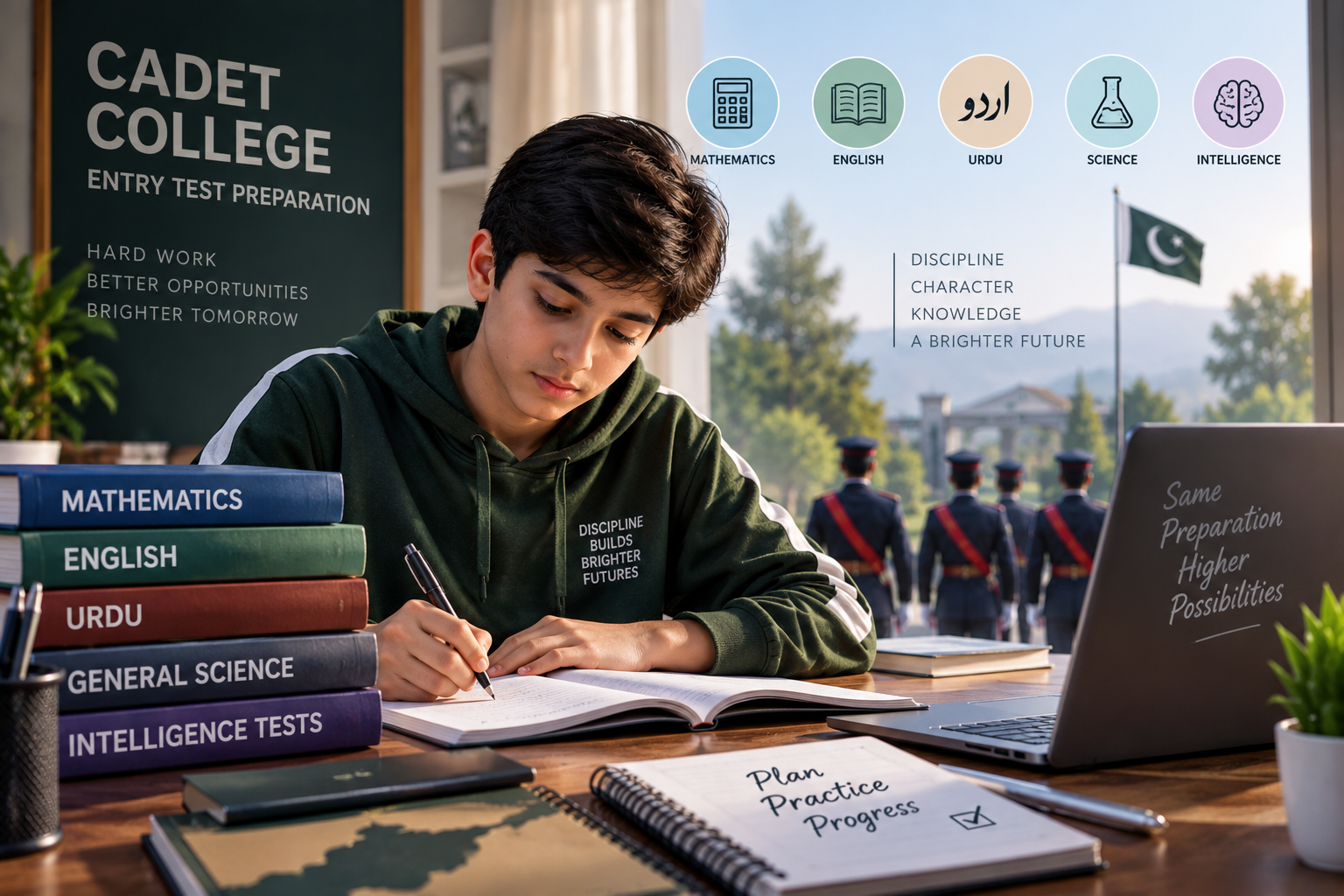
Getting ready for a cadet college entry test can become confusing very quickly. Parents often hear that their child should prepare Mathematics, English, Urdu, Science, Intelligence, Islamiat and General Knowledge — but then discover that the actual subjects differ from one institution to another.
That distinction is important.
There is no single universal entry-test syllabus followed by every cadet, military and PAF college in Pakistan. The subjects, class level, paper format and selection stages depend on the institution and the class for which a student is applying.
This guide gives parents and students a clear overview of the major subjects commonly tested and explains how to build a preparation plan for the 2027 admission cycle without relying on guesswork.
Important: Always compare your preparation with the latest syllabus or prospectus issued by the specific college. This guide explains the common preparation areas across major institutions; it does not replace an institution's official admission notice.
Is the Cadet College Entry Test Syllabus the Same Everywhere?
No.
Different institutions have different academic and selection requirements.
For example, Pakistan Scouts Cadet College Batrasi currently states that its Class VII written examination is based on the Class VI syllabus and includes:
- English
- Urdu
- Mathematics
Military College Jhelum has a broader Class VIII written examination covering:
- English
- Mathematics
- General Science
- Urdu
- Islamiat
- Pakistan Studies for non-Muslim candidates
It also includes an Intelligence Test later in its selection procedure.
PAF College Sargodha currently follows another pattern. Candidates first undergo a computer-based Intelligence Test. Those who qualify then take an academic test containing:
- Mathematics
- General Science
- English
- Urdu
Cadet College Hasanabdal also publishes its own detailed syllabus for admission testing.
Therefore, the correct strategy is not:
“Prepare one generic cadet-college paper.”
It should be:
“Build strong fundamentals in the commonly tested subjects, then prepare specifically for the institution being targeted.”
Common Cadet College Entry Test Subjects
Across major admission tests, students are likely to encounter several of the following areas:
- Mathematics
- English
- Urdu
- General Science
- Intelligence / Reasoning
- Islamiat
- Pakistan Studies
- General Awareness or General Knowledge
Not every college tests every subject.
Before beginning serious preparation, parents should identify:
- the college being targeted;
- the admission class;
- the official test subjects;
- the syllabus level;
- whether the paper is objective, subjective or mixed;
- whether an Intelligence Test is included;
- whether an interview and medical examination follow the written test.
Mathematics Preparation
Mathematics is one of the most important recurring subjects across cadet, military and PAF college entry tests.
The exact syllabus differs by institution and class, but preparation should develop three things:
- conceptual understanding;
- calculation accuracy;
- speed.
A student who knows formulas but cannot recognise which concept a word problem requires may struggle in a competitive paper.
Important Mathematics Areas
Depending on the student's class level, preparation may include:
- whole numbers;
- addition, subtraction, multiplication and division;
- factors and multiples;
- HCF and LCM;
- fractions;
- decimals;
- percentages;
- ratio and proportion;
- averages;
- unitary method;
- measurement;
- perimeter;
- area;
- basic geometry;
- angles;
- simple algebraic concepts;
- time and distance;
- everyday word problems;
- mental mathematics.
The exact topics should always be checked against the targeted institution's syllabus.
Focus on Word Problems
Word problems reveal whether a student actually understands Mathematics.
Instead of only practising:
25% of 400 = ?
students should also learn to solve contextual questions involving percentages, ratios, measurements, money, distance and time.
Students should practise identifying:
- what information is given;
- what must be found;
- which operation is required;
- whether the final answer is reasonable.
Practise Without a Calculator
Many competitive school-level entry tests are designed around mental and written calculation.
Students should therefore become comfortable with:
- multiplication tables;
- quick division;
- fraction conversions;
- percentage calculations;
- estimation;
- checking answers mentally.
Speed should be developed gradually. Accuracy should come first.
English Entry Test Preparation
English is another major component of most cadet-college admission examinations.
Preparation should not be limited to memorising vocabulary lists.
Students generally need to develop:
- grammar;
- vocabulary;
- reading comprehension;
- sentence understanding;
- written expression.
English Grammar Topics
Useful areas to revise include:
- nouns;
- pronouns;
- verbs;
- adjectives;
- adverbs;
- prepositions;
- conjunctions;
- articles;
- tenses;
- subject-verb agreement;
- active and passive voice where appropriate;
- direct and indirect speech where appropriate;
- sentence correction;
- punctuation;
- singular and plural forms.
The depth of these topics should correspond to the class level required by the college.
Vocabulary Preparation
Students should work on:
- synonyms;
- antonyms;
- word meanings;
- correct word usage;
- spelling;
- contextual vocabulary.
Avoid memorising hundreds of unrelated difficult words.
A better approach is to learn vocabulary through reading.
When a student encounters a new word:
- identify its meaning;
- understand it in context;
- identify a synonym or antonym;
- use it in a new sentence.
Reading Comprehension
Reading comprehension deserves regular practice.
A student may be asked to read a passage and identify:
- the main idea;
- factual information;
- meaning from context;
- a suitable title;
- the writer's intended meaning;
- answers based on the passage.
The best way to improve comprehension is through regular reading rather than last-minute memorisation.
Urdu Preparation
Urdu is included in the admission process of several important institutions and should not be treated as a secondary subject.
Students should revise grade-appropriate:
- grammar;
- vocabulary;
- reading comprehension;
- sentence structure;
- word meanings;
- singular and plural forms;
- synonyms and antonyms;
- textbook-based language concepts.
The exact paper format varies between institutions.
Why Students Lose Easy Marks in Urdu
Some students devote most of their preparation time to Mathematics and English and leave Urdu for the final few days.
This can be costly.
If Urdu is part of the official paper, it contributes to the candidate's overall performance just like the other tested subjects.
A student should therefore include Urdu practice in the weekly timetable from the beginning.
General Science Preparation
Science appears prominently in institutions such as Military College Jhelum, PAF College Sargodha and Cadet College Hasanabdal.
Science preparation should emphasise understanding rather than memorising isolated facts.
Depending on the required class level, important areas may include concepts from:
- living organisms;
- human body systems;
- plants;
- matter;
- force and motion;
- energy;
- heat;
- light;
- sound;
- electricity;
- environment;
- Earth and space;
- basic chemistry;
- basic physics;
- everyday scientific applications.
Students should follow the syllabus level specified by the target college.
Understand Why, Not Only What
Suppose a student knows:
Metals conduct electricity.
That is useful.
But competitive preparation should also encourage questions such as:
- why are metals used in electrical wiring?
- what properties make copper useful?
- which material would be unsuitable and why?
Conceptual understanding makes it easier to answer unfamiliar questions.
Intelligence Test Preparation
Intelligence testing is particularly important for institutions whose selection process specifically includes reasoning or aptitude assessment.
These tests are designed differently from normal textbook examinations.
Students may encounter:
Verbal Intelligence
Common question styles can include:
- number series;
- letter series;
- analogies;
- classification;
- odd-one-out;
- coding and decoding;
- relationships;
- direction questions;
- simple logical reasoning.
Non-Verbal Intelligence
Students may encounter:
- figure sequences;
- missing figures;
- pattern completion;
- figure analogy;
- rotation;
- mirror images;
- odd figure;
- embedded figures;
- spatial reasoning.
The objective should not be to memorise individual questions.
Students should understand the logic behind each question type.
How to Improve Intelligence-Test Performance
Intelligence preparation can be divided into three stages.
Stage 1: Learn the Question Types
At first, allow the student enough time to understand how each type works.
Accuracy matters more than speed.
Stage 2: Mixed Practice
Once individual categories become familiar, mix several reasoning types into one practice session.
This teaches the student to recognise the correct method independently.
Stage 3: Timed Tests
Finally, introduce strict timing.
Students need to learn when to:
- solve immediately;
- eliminate impossible options;
- temporarily skip a difficult question;
- return later if time allows.
Intelligence tests often reward quick recognition, so timed practice becomes increasingly important closer to the examination.
Islamiat and Pakistan Studies
Some institutions also include Islamiat as part of the written examination.
Military College Jhelum, for example, currently includes Islamiat in its objective paper, with Pakistan Studies used for non-Muslim candidates.
Preparation should follow the institution's stated syllabus rather than using unnecessarily advanced material.
Depending on class level, Islamiat preparation may involve:
- fundamental Islamic beliefs;
- Seerat-un-Nabi ﷺ;
- important Islamic events;
- worship;
- morals and manners;
- Quranic teachings covered at school level;
- textbook exercises.
For non-Muslim candidates, parents should confirm the institution's alternative-subject policy.
General Knowledge and General Awareness
Some institutions or interview processes may assess a student's general awareness even when it is not a separate major academic paper.
Students should develop age-appropriate awareness of:
- Pakistan;
- provinces and major cities;
- important national personalities;
- geography;
- basic world knowledge;
- important national events;
- everyday science;
- current awareness appropriate to the student's age.
General knowledge preparation should not consume the majority of study time when the main written examination is focused on academic subjects.
Objective and Subjective Papers
Another important difference between institutions is the paper format.
Some admission tests rely heavily on MCQs, while others combine objective and subjective questions.
Military College Jhelum currently provides a clear example.
Its published Class VIII paper pattern includes:
Objective Paper – 200 marks
covering:
- English;
- Mathematics;
- General Science;
- Urdu;
- Islamiat.
It also has a:
Subjective Paper – 100 marks
covering:
- English;
- Urdu.
This means a candidate targeting MCJ should not prepare through MCQs alone.
Writing skills matter too.
Why Official Sample Papers Matter
Official specimen papers and past papers can be extremely useful.
They can show:
- question style;
- difficulty level;
- subject balance;
- expected writing;
- paper organisation;
- time pressure.
PAF College Sargodha publishes syllabus/specimen material for Intelligence, General Science and Mathematics, and English and Urdu.
Military College Jhelum also publishes Class VIII past papers and its current paper pattern.
Candidates should prioritise official samples over random social-media worksheets whenever official material is available.
Class VII vs Class VIII Preparation
Parents sometimes search for one generic “cadet college syllabus,” but the admission class matters significantly.
A Class VII admission test may be based primarily on Class VI knowledge.
A Class VIII admission test may require concepts from earlier classes through Class VII.
For example, Pakistan Scouts Cadet College Batrasi states that its Class VII test is based on the Class VI syllabus.
Military College Jhelum states that its Class VIII written test covers material from Classes V to VII under its published system.
Therefore, always begin preparation by answering:
Which class is my child applying for?
A Practical Daily Study Routine
A balanced preparation routine could look like:
Mathematics – 45 Minutes
- revise one concept;
- solve topic questions;
- finish with several word problems.
English – 30 Minutes
- grammar or comprehension;
- vocabulary practice.
Urdu – 20 to 30 Minutes
- grammar;
- reading;
- textbook revision.
Science – 30 Minutes
For institutions that test Science:
- revise one concept;
- answer conceptual questions.
Intelligence – 20 Minutes
For institutions requiring it:
- practise one or two reasoning categories.
The exact duration should depend on the student's age, school workload and current level.
Long hours are not automatically better.
A focused 90-minute session can be more productive than several distracted hours.
A Six-Day Weekly Preparation Plan
A student could use the following structure:
Monday
- Mathematics
- English Grammar
- Verbal Intelligence
Tuesday
- Mathematics
- Urdu
- Science
Wednesday
- English Comprehension
- Mathematics
- Non-Verbal Intelligence
Thursday
- Science
- Urdu
- English Vocabulary
Friday
- Mathematics mixed questions
- Intelligence
- Revision
Saturday
- Full or partial mock test
- Error analysis
Sunday
- Light revision or rest depending on the student's needs
A preparation plan should remain flexible.
Weak subjects need more time than subjects the student already handles comfortably.
The Importance of Mock Tests
Mock tests serve several purposes.
They tell us:
- whether the syllabus has actually been understood;
- which topics remain weak;
- whether the student can manage time;
- whether careless mistakes are frequent;
- whether exam pressure affects performance.
However, taking many tests without reviewing them is not effective.
After every test, divide incorrect answers into categories:
Concept Error
The student did not understand the topic.
Solution: Learn the concept again.
Careless Error
The student knew the answer but made a calculation or reading mistake.
Solution: Improve checking habits.
Time Error
The student could solve the question but took too long.
Solution: Practise similar questions under timing.
Language Error
The student misunderstood the question.
Solution: Improve reading and vocabulary.
This turns test scores into useful preparation information.
Common Preparation Mistakes
Preparing Every College Exactly the Same Way
Cadet colleges do not all use identical tests.
Check the targeted institution first.
Depending Only on MCQs
Some institutions assess subjective writing as well.
Ignoring Intelligence Tests
This is especially dangerous when intelligence testing is a qualifying stage.
PAF College Sargodha currently requires candidates to qualify its computer-based Intelligence Test before proceeding to the academic test.
Starting Timed Practice Too Early
Students who do not yet understand the material may develop bad guessing habits.
Concepts should come first.
Starting Timed Practice Too Late
Students also need enough time to become comfortable working under examination pressure.
Using Only Difficult Questions
Competitive preparation should contain easy, moderate and difficult questions.
A candidate must secure straightforward marks efficiently before spending excessive time on the hardest questions.
Ignoring Official Material
If a college provides its own syllabus, model paper or past paper, use it.
Preparing for More Than One Cadet College
Many families apply to multiple institutions.
This can actually make preparation more efficient if handled correctly.
Start by building the shared foundation:
- Mathematics;
- English;
- Urdu;
- Science;
- Intelligence.
Then create institution-specific preparation.
For example:
Batrasi-focused preparation
may emphasise its Class VII English, Urdu and Mathematics requirements.
Military College Jhelum preparation
needs broader Class VIII academic coverage along with Intelligence preparation.
PAF College Sargodha preparation
must account for its Intelligence-Test-first selection process and subsequent academic e-testing.
This approach prevents students from starting from zero for every application.
How Parents Should Choose Preparation Material
Before buying books or enrolling in a preparation program, parents should ask:
- Is the material appropriate for the child's admission class?
- Does it correspond to the target institution?
- Does it explain concepts or only provide answers?
- Are there timed tests?
- Are mistakes reviewed?
- Does it include the correct subjects?
- Is official sample material being used?
More books do not automatically mean better preparation.
A smaller amount of relevant material completed properly is usually more useful than piles of unfinished books.
Preparing With Ikram Forces Academy Sargodha
Ikram Forces Academy Sargodha helps students prepare for competitive cadet-college and related admission tests through structured academic practice and examination-focused preparation.
Rather than treating every student identically, preparation should identify:
- strong subjects;
- weak subjects;
- conceptual gaps;
- test-taking speed;
- accuracy;
- reasoning ability.
A student who understands Mathematics but works slowly needs a different plan from a student who completes questions quickly but lacks basic concepts.
Similarly, a student preparing for Batrasi may require a different subject balance from one preparing for PAF College Sargodha or Military College Jhelum.
The objective should be to prepare for the actual admission requirements of the targeted institution, not simply complete a generic preparation book.
Final Preparation Checklist
Before the examination approaches, parents and students should be able to answer the following:
- Which college are we applying to?
- Which class is the admission for?
- What subjects are officially tested?
- What class-level syllabus applies?
- Is there an Intelligence Test?
- Is the paper objective, subjective or both?
- Have official specimen papers been attempted?
- Have weak topics been identified?
- Has timed practice begun?
- Is the student reviewing mistakes?
- Is interview preparation required after the written examination?
- Are current admission instructions being checked from the official college?
If several of these answers are still unclear, preparation should be made more specific.
Final Advice
There is no single shortcut to every cadet college entry examination.
The strongest preparation strategy is:
- understand the exact target college;
- confirm its current syllabus;
- strengthen academic fundamentals;
- practise Intelligence where required;
- use official sample material;
- introduce timed tests gradually;
- analyse mistakes;
- prepare specifically for the institution.
Parents should also remember that admission procedures and syllabi can change between admission cycles.
For the 2027 admission season, always verify the latest requirements from the official website or prospectus of the college your child is applying to.
A strong foundation in Mathematics, English, Urdu, Science and reasoning can prepare a student for many competitive examinations — but the final stage of preparation should always be aligned with the specific college's official test pattern.